The Shadow Inventors: The Mathematicians Who Built Modern Encryption in Secret
Readholmes Editorial Team
March 23, 2026
0
The Shadow Inventors: The Mathematicians Who Built Modern Encryption in Secret
In the grand narrative of technological progress, we often look to Silicon Valley or the burgeoning labs of the 1990s as the birthplace of our digital world. We celebrate the heroes of the internet age the founders who brought us connectivity, privacy, and secure commerce. But the true foundation of the modern internet the very thing that allows you to read this article securely was laid not in a garage in California, but in the sterile, high-security corridors of the British Government Communications Headquarters (GCHQ) in the late 1960s.
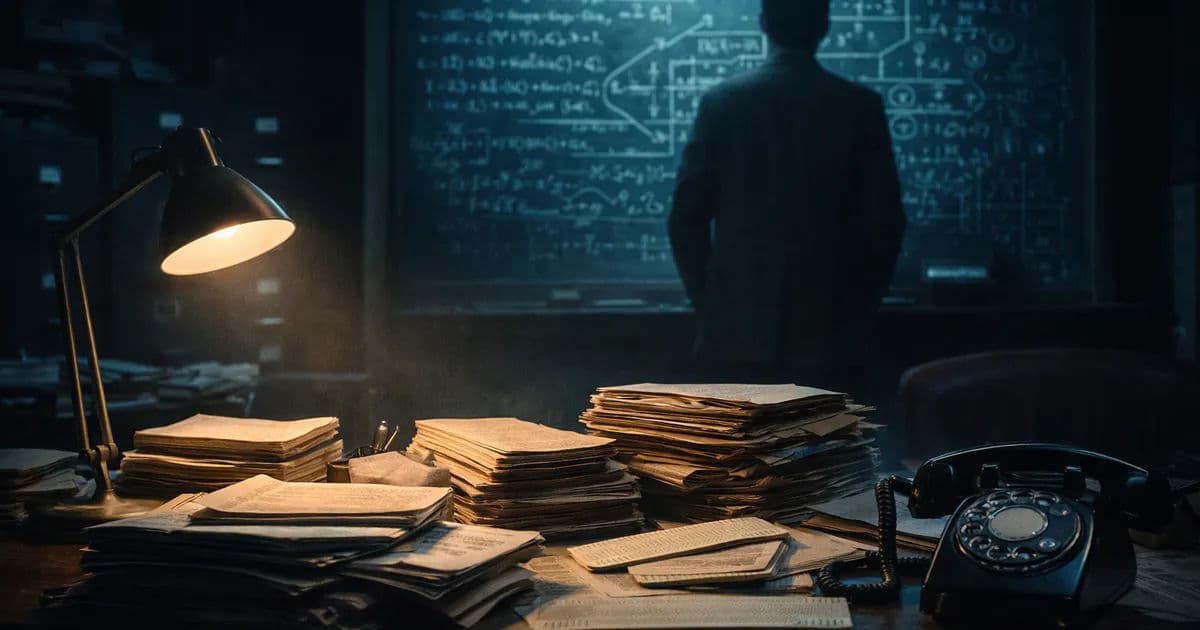
For nearly four decades, a small group of British mathematicians solved the most complex problem in cryptography, only to have their work locked away in a filing cabinet. Their discovery, which would have revolutionized global communications had it been released, was classified as a national security secret. It was a discovery that would eventually be independently reinvented in the United States, leading to the public-key encryption standards we rely on today. This is the story of the mathematicians who were forced to watch from the shadows as the world "invented" the solution they had already perfected.
The Impossible Problem: The Key Distribution Crisis
To understand why this discovery was so monumental, we must first understand the state of cryptography before the 1970s. For thousands of years, encryption was based on a simple concept: symmetric keys.
Imagine you want to send a secret message to a friend. You agree on a codebook beforehand. If you use the codebook to lock the message, your friend must have the exact same codebook to unlock it. This works perfectly if you are standing next to each other. But what happens if you are on opposite sides of the world?
The Security Paradox
Before the invention of public-key cryptography, the "Key Distribution Problem" was the single greatest barrier to secure communication. If you wanted to send an encrypted message to someone you hadn't met, you first had to find a secure way to send them the key. But if you had a secure channel to send the key, why did you need to encrypt the message in the first place?
It was a circular, frustrating logic that kept secure communication limited to governments, military organizations, and high-level diplomats. For the average person, or even for businesses, truly secure communication was practically impossible.
The GCHQ Breakthrough: James Ellis
In the late 1960s, James Ellis, a British engineer and mathematician working for GCHQ, became obsessed with this problem. He was not satisfied with the status quo. He spent his time thinking about whether it was possible to create a system where the encryption key was public, but the decryption key remained private.
It sounded like a logical contradiction. How can you encrypt something using information that is public, without also making it easy for an attacker to decrypt it?
In 1969, Ellis had his "eureka" moment. He realized that if you could create a mathematical process that was easy to perform in one direction but practically impossible to reverse without a specific piece of information, you could solve the key distribution problem. He called it "non-secret encryption."
The Reaction of the Establishment
Ellis brought his idea to his superiors. The response was underwhelming. While they acknowledged the mathematical brilliance of his theory, they could not conceive of a practical way to implement it. It was a theoretical curiosity, a "nice to have" that didn't seem to have a real-world application at the time. Ellis was told to keep working, but his discovery was effectively buried under a mountain of bureaucratic indifference and the strict requirements of national security.
Enter Clifford Cocks: The Man Who Invented RSA
If James Ellis provided the theory, it was Clifford Cocks who provided the proof. In 1973, a young mathematician joined the GCHQ team. Ellis shared his ideas about non-secret encryption with Cocks. Within a few hours, Cocks had solved the puzzle.
Cocks realized that number theory specifically, the difficulty of factoring large prime numbers was the key. He devised a system that was, for all intents and purposes, identical to what would later be known as the RSA algorithm (named after Rivest, Shamir, and Adleman).
Feature
Symmetric Encryption
Asymmetric Encryption (Cocks/Ellis)
Key Management
Requires shared secret key
Public key for encryption, private for decryption
Scalability
Poor (requires key exchange)
Excellent (keys can be shared openly)
Performance
Faster
Slower (requires more computation)
Primary Use
Bulk data encryption
Key exchange & Digital signatures
Cocks had effectively invented modern digital security. He had the math. He had the logic. He had the proof. And he had to bury it.
The Tragedy of Secrecy
Why didn't GCHQ release this? The answer lies in the Cold War mindset. GCHQ’s primary objective was signals intelligence intercepting and breaking the codes of the Soviet Union. If they released a method that made communication perfectly secure, they would be effectively blinding their own intelligence capabilities.
Warning: The decision to keep these findings classified was not an act of malice, but a calculated strategic choice based on the geopolitical climate of the 1970s. Intelligence agencies prioritize their ability to listen over the public's right to digital privacy.
For 40 years, Clifford Cocks and James Ellis sat on the most important cryptographic discovery of the century. They watched as the world struggled with the key distribution problem. They watched as the internet began to take shape in the 1980s, desperate for a way to secure transactions. They remained silent, bound by the Official Secrets Act, while academics in the United States stumbled toward the same realization.
The American Rediscovery: Diffie, Hellman, and Merkle
While the British were keeping their secrets, the American academic community was beginning to tackle the same problem. In the mid-1970s, Whitfield Diffie, Martin Hellman, and Ralph Merkle independently arrived at the concept of public-key cryptography.
Their work culminated in the 1976 paper, New Directions in Cryptography. It was a watershed moment. Unlike the GCHQ team, the American researchers were working in the open. Their work sparked a revolution. When Rivest, Shamir, and Adleman developed the RSA algorithm in 1977, it became the standard that would eventually secure the entire internet, from banking websites to secure messaging apps.
The Declassification: A Quiet Admission
It wasn't until 1997 that the British government finally declassified the work of Ellis, Cocks, and Williamson (another GCHQ mathematician who had contributed to the work). The announcement was quiet, almost anticlimactic. The world was already running on the encryption methods the British had discovered decades prior.
When the news broke, it was a shock to the cryptographic community. The "American" invention of public-key cryptography was, in fact, a British invention that had been gathering dust in a filing cabinet for nearly half a century.
How Modern Encryption Actually Works (Simplified)
To appreciate what Cocks and Ellis achieved, it helps to understand the mechanism. Modern encryption relies on a mathematical trapdoor function.
The Math: You take two very large prime numbers and multiply them together. It is easy for a computer to do this.
The Trapdoor: If you only have the result (the product), it is computationally impossible (within a reasonable timeframe) for a computer to figure out which two prime numbers you started with. This is the "trapdoor."
The Public Key: You make the product public. Anyone can use it to encrypt a message to you.
The Private Key: Only you know the original two prime numbers. Only you can use them to unlock the message.
This simple, elegant math is what protects your credit card information, your private emails, and your government records. It is the invisible shield of the digital age.
Click to expand: The Role of Prime Numbers
Prime numbers are the atoms of arithmetic. They are numbers that cannot be divided by anything other than 1 and themselves. Because they are the building blocks of all integers, their distribution is the subject of intense mathematical study. In encryption, we use prime numbers that are hundreds of digits long. The sheer number of possibilities makes it impossible for even the most powerful supercomputers to guess the original factors in a reasonable amount of time.
The Legacy of the Silent Mathematicians
James Ellis passed away in 1997, just months before his work was declassified. He never saw the world recognize him as the father of modern cryptography. Clifford Cocks, however, lived to see his work vindicated. He later became the Chief Mathematician at GCHQ and was recognized for his contributions to both national security and the broader advancement of mathematics.
Their story is a poignant reminder of the tension between national security and public technological advancement. It raises uncomfortable questions: How many other breakthroughs are currently locked in government filing cabinets? How much faster could our society have progressed if these secrets had been shared?
Key Takeaways
Innovation is often independent: Multiple people often arrive at the same discovery at the same time, driven by the same problems.
Security is a double-edged sword: The same tools that protect our privacy also hinder intelligence agencies, creating a constant tug-of-war.
The importance of open science: The rapid adoption of public-key encryption in the 1990s was only possible because the American researchers published their work openly, allowing the global community to build upon it.
Frequently Asked Questions
1. Why did GCHQ keep the discovery secret for so long?
During the Cold War, the priority was signals intelligence. Agencies like GCHQ and the NSA believed that if unbreakable encryption became widespread, they would lose their ability to monitor threats. They prioritized intelligence gathering over the public benefit of secure communication.
2. Who gets the credit for inventing public-key encryption?
Today, credit is generally shared. Whitfield Diffie, Martin Hellman, and Ralph Merkle are credited for the public discovery that launched the industry, while James Ellis, Clifford Cocks, and Malcolm Williamson are credited for the original, classified discovery.
3. Is modern encryption still based on these original discoveries?
Yes. While the algorithms have evolved (we now use more complex variations like Elliptic Curve Cryptography), the fundamental principle of asymmetric encryption the "trapdoor" function remains the core of almost all secure internet communication.
4. Could someone discover a way to break this encryption tomorrow?
It is theoretically possible. Quantum computing poses a potential threat to current encryption standards because quantum computers could theoretically factor large numbers much faster than classical computers. This is why the industry is currently transitioning to "post-quantum cryptography."
Summary
The story of the GCHQ mathematicians is not just a footnote in history; it is a fundamental chapter in the story of the internet. It serves as a reminder that the technology we take for granted the secure locks on our digital doors was the result of human genius, often operating in the shadows. By understanding the origins of encryption, we gain a deeper appreciation for the delicate balance between security, privacy, and innovation that defines our modern digital landscape.
Disclaimer: This article is for informational and educational purposes only and does not constitute financial or technical advice. The information provided is based on historical records and technological concepts and should not be used as a basis for security implementations or investment decisions.
Share this article
Comments (0)
No comments yet. Be the first to comment!
R
Written by
Fact-Checked Editorial Team
Readholmes Editorial Team
Senior Editor & Subject Matter Specialist at Readholmes. Content is rigorously fact-checked and reviewed against Google Search Quality Rater Guidelines for accuracy, timeliness, and user helpfulness.
Why the Ocean Floor Holds More Secrets About Human History Than Every Museum on Earth Combined
While museums curate a fraction of our past, the ocean floor hides vast, untouched archives of human civilization. Explore why the deep sea is the ultimate repository of our forgotten history.
Cracking the Code: How AI Is Resurrecting Languages Lost for 3,000 Years
Artificial intelligence is transforming archaeology by deciphering ancient scripts that have remained silent for millennia, offering a new bridge to our forgotten past.
While a universal 'cure' for cancer remains elusive, the landscape of oncology is shifting from broad-spectrum treatments to highly personalized, precision medicine. This article explores the current breakthroughs, the challenges of cancer heterogeneity, and what the future of cancer care actually looks like.