Three NASA Rockets Dive Into the Electric Heart of the Northern Lights
Readholmes Editorial Team
February 27, 2026
0
For centuries, the Northern Lights or Aurora Borealis have been viewed as a mystical celestial dance. But to NASA scientists, these shimmering curtains of light represent something far more practical and powerful: a massive, natural electrical circuit.
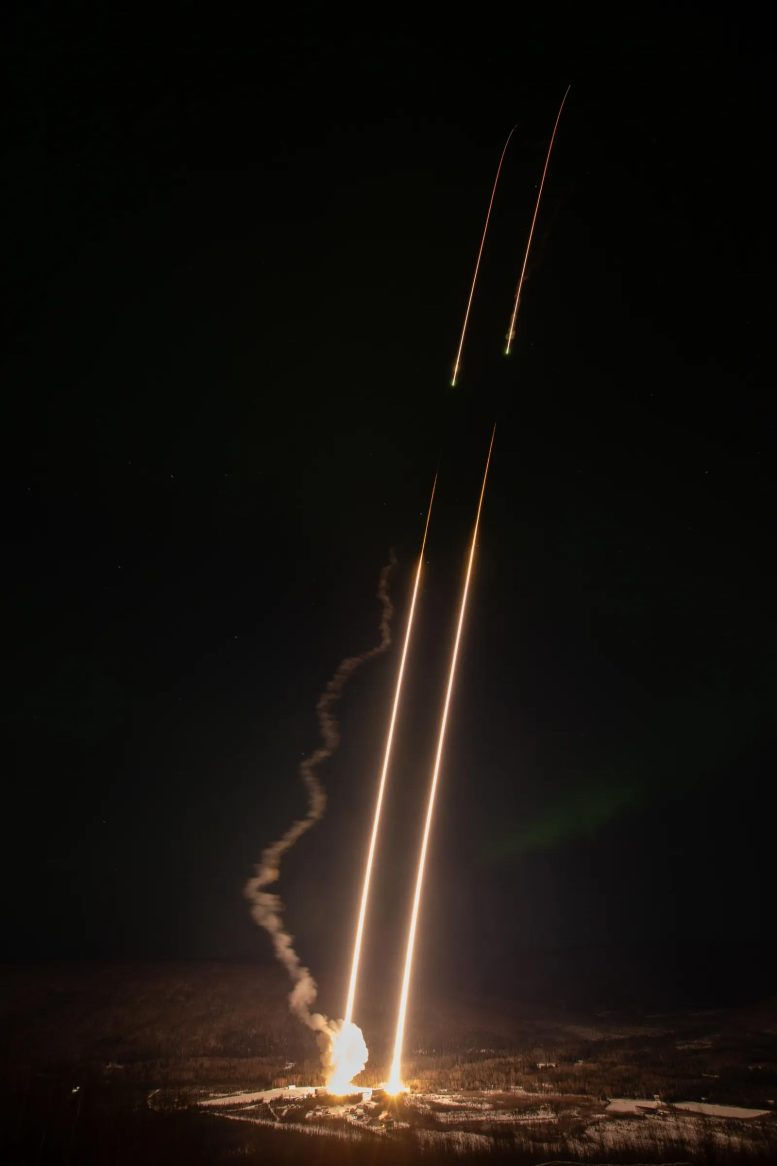
Recently, NASA embarked on a daring mission to understand the mechanics of this circuit. By launching three sounding rockets directly into the "electric heart" of an active aurora, researchers are attempting to measure the invisible forces that govern the boundary between Earth’s atmosphere and the vacuum of space. This article explores why these rockets were launched, what they hope to find, and why understanding the aurora is critical for our modern, tech-dependent lives.
The Mission: Piercing the Glowing Veil
Most people view the aurora from the ground, looking up at the light. NASA’s latest mission, however, takes the opposite approach. By flying through the aurora, these rockets can sample the environment in situ meaning they are physically present where the action happens.
Unlike satellites, which orbit hundreds of miles above the Earth, or weather balloons, which stay relatively low, sounding rockets occupy a unique niche. They are designed to fly a parabolic path, spending about five to ten minutes in the "ignore-osphere" the region of the upper atmosphere that is too high for planes but too low for most satellites to maintain a stable orbit.
Why Three Rockets?
To understand a complex system like the aurora, a single data point isn't enough. NASA utilized a trio of rockets to create a three-dimensional map of the atmospheric changes.
The First Rocket: Acts as a scout, measuring the initial density of the neutral gas and the charged plasma.
The Second Rocket: Deployed to a different altitude to measure how electrical currents flow vertically.
The Third Rocket: Completes the picture by tracking the horizontal movement of winds and energy dissipation.
The Science of the "Electric Heart"
The aurora is more than just a light show; it is the visible manifestation of Joule heating. When solar wind—a stream of charged particles from the sun—hits Earth’s magnetic field, it funnels energy toward the poles. This energy slams into the gases in our atmosphere, specifically the ionosphere.
The Friction Between Ions and Neutrals
At these altitudes, two types of matter coexist:
Ions: Atoms that have been stripped of electrons and carry an electric charge.
Neutrals: Standard gas molecules that carry no charge.
Under normal conditions, these two groups don't interact much. However, during an aurora, the ions are whipped into a frenzy by electromagnetic forces. As they move at high speeds, they crash into the slower, stationary neutral molecules. This "friction" creates heat on a massive scale.
This process can change the density of the atmosphere so significantly that it actually creates "potholes" in the sky for satellites.
Why This Research Matters for Life on Earth
You might wonder why we spend millions of dollars flying rockets into colorful lights. The answer lies in the technology we use every day. The ionosphere is the medium through which GPS signals, satellite communications, and radio waves travel.
Impact Area
How the Aurora Affects It
GPS Accuracy
Atmospheric turbulence can delay signals, leading to location errors of several meters.
Satellite Health
Increased heat causes the atmosphere to expand, creating "drag" that can pull satellites out of orbit.
Power Grids
Intense auroral activity can induce currents in ground-based power lines, potentially causing blackouts.
Communications
High-frequency radio waves used by aviation and maritime industries can be absorbed or reflected.
[IMAGE PROMPT]: A split-screen digital illustration. On the left side, a clear sky with a straight, clean signal line moving from a satellite to a smartphone on Earth. On the right side, an active, wavy Aurora Borealis causes the signal line to become distorted, jagged, and broken before it reaches the phone. The smartphone screen on the right shows a "Signal Lost" error. The style is sleek, tech-oriented, and easy to understand.
The Challenges of the Hunt
Launching rockets into an aurora is not as simple as hitting a "fire" button. It requires immense patience and precision. Scientists must wait for a "clear" night—not just in terms of clouds, but in terms of geomagnetic activity.
The Launch Window: Researchers often sit in frozen bunkers in places like Poker Flat, Alaska, for weeks. They wait for the specific moment when the solar wind is strong enough to trigger an aurora directly over the launch site.
The Timing: If the rocket is launched five minutes too early or too late, it might miss the peak electrical activity, rendering the mission a failure.
The Recovery: While the data is beamed back via telemetry, the physical rocket components often fall back into remote, uninhabited wilderness, where they are sometimes recovered for study.
Warning: Space weather is unpredictable. Even with the best forecasting models, the "electric heart" of the aurora can shift or fade in seconds, making these missions some of the most stressful in the aerospace world.
What We Expect to Learn
By analyzing the data from these three rockets, NASA hopes to refine our models of the upper atmosphere. Current models are often too simple; they treat the atmosphere like a uniform gas. The reality is a turbulent, churning sea of plasma and neutral wind.
By understanding exactly how much energy is transferred during an aurora, scientists can better predict "space weather." This allows satellite operators to adjust orbits in advance and power grid managers to protect infrastructure before a surge occurs.
FAQ
Q: Do these rockets contribute to space junk?
No. Sounding rockets are sub-orbital. They go up and come right back down, usually landing in designated, uninhabited zones or the ocean, rather than staying in orbit.
Q: Is the aurora dangerous to people on the ground?
Not directly. The atmosphere protects us from the charged particles. The danger is strictly to our electronic infrastructure and satellites.
Q: Can these rockets see colors we can't?
Yes. The instruments on board can detect ultraviolet and X-ray emissions that are invisible to the human eye, providing a much fuller picture of the energy involved.
Summary of Key Takeaways
The Mission: NASA used three sounding rockets to measure the interaction between charged ions and neutral gases within the Aurora Borealis.
The Goal: To understand "Joule heating," the process by which the aurora heats the upper atmosphere.
The Impact: Better data helps protect GPS, satellite communications, and national power grids from space weather disruptions.
The Method: Sounding rockets are the only tools capable of taking direct measurements in the specific altitude where the aurora occurs.
Disclaimer: This article is for informational purposes only and describes scientific research conducted by NASA. It does not provide technical advice for aerospace engineering or satellite management.
Share this article
Comments (0)
No comments yet. Be the first to comment!
R
Written by
Fact-Checked Editorial Team
Readholmes Editorial Team
Senior Editor & Subject Matter Specialist at Readholmes. Content is rigorously fact-checked and reviewed against Google Search Quality Rater Guidelines for accuracy, timeliness, and user helpfulness.
The Shadow Inventors: The Mathematicians Who Built Modern Encryption in Secret
Decades before the internet became the backbone of global commerce, British mathematicians at GCHQ solved the greatest riddle in cryptography, only to be silenced by the Official Secrets Act.
Why the Ocean Floor Holds More Secrets About Human History Than Every Museum on Earth Combined
While museums curate a fraction of our past, the ocean floor hides vast, untouched archives of human civilization. Explore why the deep sea is the ultimate repository of our forgotten history.
Cracking the Code: How AI Is Resurrecting Languages Lost for 3,000 Years
Artificial intelligence is transforming archaeology by deciphering ancient scripts that have remained silent for millennia, offering a new bridge to our forgotten past.