Why the Ocean Floor Holds More Secrets About Human History Than Every Museum on Earth Combined
Readholmes Editorial Team
March 22, 2026
0
Why the Ocean Floor Holds More Secrets About Human History Than Every Museum on Earth Combined
We walk through the halls of the British Museum, the Louvre, or the Smithsonian, marveling at the artifacts of antiquity. We see pottery shards, gold coins, and fragmented statues, all carefully labeled and displayed behind glass. These institutions are the gatekeepers of our collective memory, yet they represent only a tiny, curated fraction of the human story. The vast majority of our history the cities that vanished, the trade routes that defined economies, and the daily lives of millions lies not in climate-controlled galleries, but on the ocean floor.
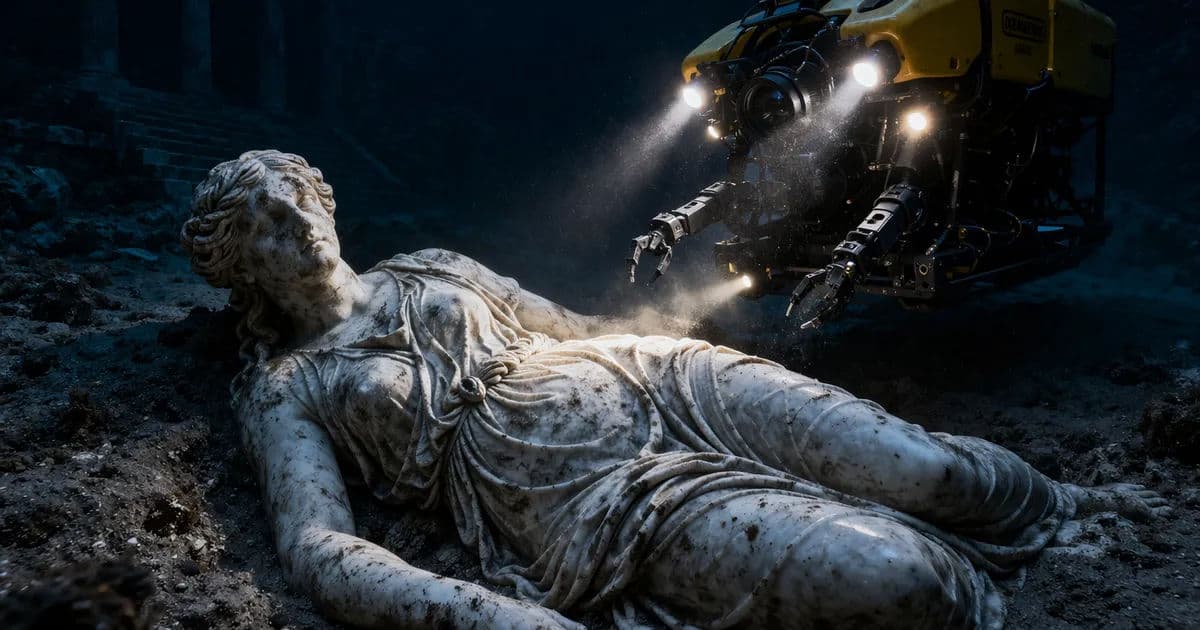
For millennia, the ocean has been both a highway for human progress and a final resting place for its failures. Today, advancements in maritime technology are finally allowing us to peer into this abyss, revealing that the ocean floor is the largest, most intact, and most significant museum of human history in existence.
The Museum Paradox: A Curated Glimpse
Museums are, by necessity, limited. They are restricted by space, funding, and the historical accidents of preservation. An artifact on display is often one of a few survivors from a site that has been largely destroyed by urban development, looting, or the slow erosion of time. When we look at a collection of Roman coins, we are seeing the handful that survived, not the millions that were lost at sea during shipwrecks.
Furthermore, museums suffer from the "bias of discovery." We find things where we look, and we look where it is easy. On land, we excavate sites that are accessible. We favor sites that have not been paved over by modern cities. The ocean, however, does not care about our convenience. It has swallowed entire civilizations whole, protecting them from the destructive forces of the surface world.
The Preservation Power of the Abyss
Why is the ocean floor such a superior repository of history compared to land-based sites? The answer lies in the unique environmental conditions of the deep sea.
Anoxic Conditions: In many deep-sea environments, the lack of oxygen prevents the decay of organic materials. Wood, leather, textiles, and even human remains can survive for centuries, if not millennia, in a state of near-perfect preservation.
Low Light and Temperature: Cold temperatures and the absence of sunlight inhibit the growth of bacteria and marine organisms that would otherwise consume wooden shipwrecks or delicate artifacts.
Minimal Human Interference: Once a site is claimed by the sea, it is often removed from the reach of looters, construction crews, and the wear and tear of daily human activity. These sites become time capsules, frozen in the exact moment of their loss.
Lost Cities: The Underwater Time Capsules
Perhaps the most compelling evidence that the ocean holds more history than museums is the existence of entire submerged cities. These are not merely shipwrecks; they are urban centers that were once vibrant hubs of trade, culture, and governance.
Thonis-Heracleion: The Egyptian Atlantis
For centuries, Thonis-Heracleion was known only from ancient texts, a mythical port city that disappeared into the Mediterranean. When underwater archaeologist Franck Goddio discovered it in the early 2000s, he didn't just find a few artifacts; he found an entire city. Massive statues, temple foundations, and thousands of everyday objects remained in their original positions, offering a view of Egyptian life that no museum exhibit could ever replicate.
Pavlopetri: The World’s Oldest Submerged City
Off the coast of Greece lies Pavlopetri, a city that dates back 5,000 years. It features intact town planning, including streets, courtyards, and tombs. Unlike land sites, where structures are often built over or dismantled for building materials, Pavlopetri remains as it was abandoned, providing an unparalleled look at Bronze Age urban organization.
The Technology of Discovery: Seeing Through the Dark
For most of human history, the ocean floor was a blank space on the map. We knew it existed, but we couldn't see it. That has changed. The revolution in maritime archaeology is driven by a suite of new technologies that allow us to map and investigate the deep sea with unprecedented precision.
Remote Sensing and AUVs
Autonomous Underwater Vehicles (AUVs) and Remotely Operated Vehicles (ROVs) have replaced the dangerous and limited human diver. These machines can spend days or weeks at depths unreachable by humans, using high-resolution cameras, side-scan sonar, and magnetometers to create 3D maps of the seabed.
Technology
Function
Benefit
Multibeam Sonar
Maps the topography of the seafloor
Identifies potential wreck sites over large areas
Magnetometers
Detects anomalies in magnetic fields
Finds metal objects buried under sediment
ROVs
Provides high-definition visual inspection
Allows for delicate excavation and recovery
AUVs
Autonomous survey and mapping
Covers vast areas without human risk
The Ethics of Deep-Sea Discovery
As we gain the ability to reach these sites, we face a new set of ethical dilemmas. The ocean floor is not just a repository of history; it is also a site of industrial activity and potential exploitation.
Deep-Sea Mining: The race for rare earth minerals and resources threatens to destroy archaeological sites before they are even discovered. Many of these sites are located in areas targeted for industrial development.
Looting and Commercial Salvage: While many shipwrecks are protected by international law, the temptation to recover gold and artifacts for profit remains a significant threat. Archaeological sites are not just about the value of the objects; they are about the context the 'where' and 'how' of the artifacts.
Climate Change: Rising sea levels and changing ocean currents are actively altering the conditions of these sites, in some cases accelerating the decay of materials that have been stable for centuries.
Frequently Asked Questions
Why haven't we explored more of the ocean floor?
Exploration is expensive, technically challenging, and the ocean is vast. We have mapped less than 25% of the ocean floor in high resolution. The deep sea is a hostile environment with immense pressure, darkness, and cold, making every mission a massive logistical undertaking.
Are all shipwrecks protected by international law?
Many are, but enforcement is difficult. The UNESCO Convention on the Protection of the Underwater Cultural Heritage provides a framework, but it relies on individual nations to police their own waters and the high seas.
Can we bring everything to the surface?
No, and we shouldn't. Artifacts are often best preserved in the environment where they were found. Bringing them to the surface can cause rapid decay due to changes in pressure, oxygen, and salinity. In situ preservation (leaving it where it is) is often the preferred archaeological approach.
How does underwater archaeology change history?
It fills in the gaps. It provides evidence of trade routes, migration patterns, and daily life that are absent from the written record. It turns myths into history and provides concrete, physical evidence of past human activity.
Summary
The ocean floor is not a graveyard of the past; it is a living archive of human history. While museums offer a window into our heritage, the deep sea holds the entire house. As technology continues to improve, we will undoubtedly discover more about our ancestors than we ever thought possible. However, this discovery comes with the responsibility to protect these sites from industrial exploitation and to prioritize historical preservation over profit. We are only just beginning to scratch the surface of the world's largest, most important museum.
Disclaimer: The information provided in this article is for educational and informational purposes only and does not constitute financial, investment, or legal advice. Always consult with qualified professionals regarding specific legal or financial matters related to cultural heritage or salvage operations.
Share this article
Comments (0)
No comments yet. Be the first to comment!
R
Written by
Fact-Checked Editorial Team
Readholmes Editorial Team
Senior Editor & Subject Matter Specialist at Readholmes. Content is rigorously fact-checked and reviewed against Google Search Quality Rater Guidelines for accuracy, timeliness, and user helpfulness.
The Shadow Inventors: The Mathematicians Who Built Modern Encryption in Secret
Decades before the internet became the backbone of global commerce, British mathematicians at GCHQ solved the greatest riddle in cryptography, only to be silenced by the Official Secrets Act.
Cracking the Code: How AI Is Resurrecting Languages Lost for 3,000 Years
Artificial intelligence is transforming archaeology by deciphering ancient scripts that have remained silent for millennia, offering a new bridge to our forgotten past.
While a universal 'cure' for cancer remains elusive, the landscape of oncology is shifting from broad-spectrum treatments to highly personalized, precision medicine. This article explores the current breakthroughs, the challenges of cancer heterogeneity, and what the future of cancer care actually looks like.